
5 mistakes businesses make with booking management
Discover the most common booking-management mistakes businesses make — and how to fix them to improve efficiency and customer satisfaction.
Slotera · 15 June 2026 · 6 min read
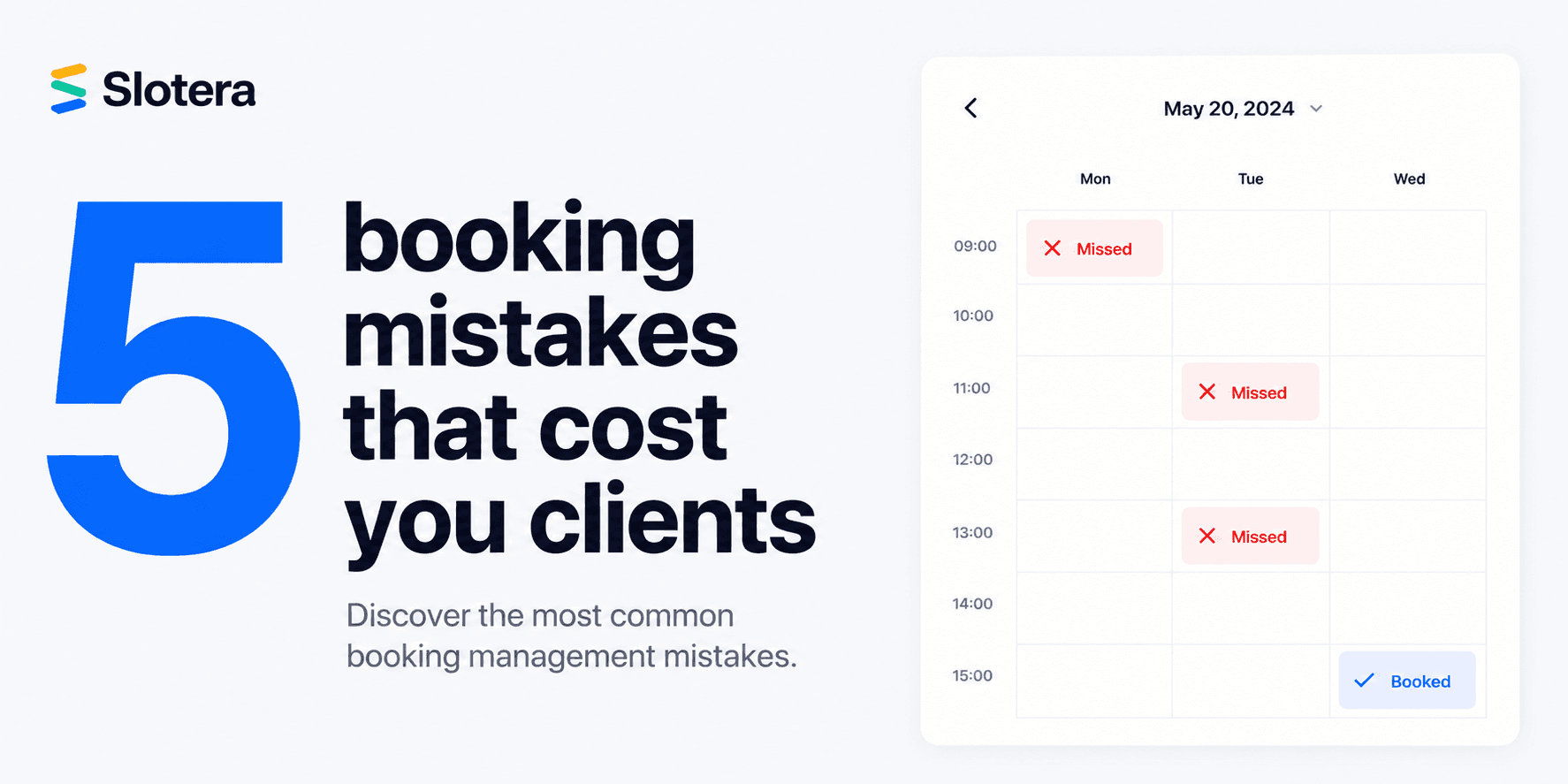
The calendar is the heart of any business. When it works well, the day flows: clients arrive on time, your team has room to breathe between services, and nobody is left waiting. When it works badly, a single mixed-up booking is enough to trigger delays, confusion and unhappy clients.
The good news is that most scheduling problems don't come from a lack of effort — they come from small organisational habits that repeat every single day. We've identified the five most common ones in businesses, and, more importantly, how to fix each of them.
1. Relying only on the phone and a paper diary
For years, the appointment book and the phone did the job. The problem is that both have clear limits: the paper diary only exists in one place, only one person can read it at a time, and a single messy correction can wipe out a whole afternoon. The phone, meanwhile, only rings when the business is open — and rarely when your team actually has a free hand to answer it.
In practice, this means lost bookings. When the line is busy or nobody can pick up, many clients simply give up and call the next business. Others ask to book by message, and the reply gets buried under dozens of notifications.
The cost adds up by the end of the month: empty slots that could have been filled, double bookings at the same time, and the constant stress of keeping everything in your head. And there's a hidden cost too — every minute your team spends on the phone is a minute not spent with the clients in front of them.
The fix is to centralise the calendar in a digital system that any device can open and that updates in real time. When the whole team sees the same calendar at once, double bookings and time clashes disappear. The paper diary stops being the single source of truth, and the business stops depending on one person to know who is coming and when.
2. Sending no reminders and living with no-shows
No-shows — clients who book and never turn up, without warning — are one of a business's biggest revenue leaks. A reserved slot that ends up empty can't be recovered: that time has passed and won't come back. When it happens two or three times a week, the monthly loss is significant.
The most common mistake is assuming the client will remember on their own. But life happens: appointments made two weeks in advance are easy to forget, especially when nothing nudges the client in between.
Many businesses try to solve this by sending manual messages, one by one, the day before. It works, but it eats up precious time and is rarely done consistently — on the busiest days, it's the first task to slip.
The fix is to automate reminders. A reminder sent by email or message, at the right time before the appointment, dramatically reduces no-shows and gives the client a chance to reschedule in advance if something comes up. Ideally the system handles this on its own, with nobody having to remember to send anything. With automatic reminders, the slot that would have sat empty can be offered to another client in time.
3. Not allowing online booking outside opening hours
A large share of people decide to book a service outside working hours — in the evening, at the weekend, on their lunch break. If the only way to book is to call during the business's opening hours, all of those intentions to book evaporate.
This is perhaps the most expensive mistake, precisely because it's invisible. The business never sees the clients who wanted to book at 10pm and couldn't; it only sees a calendar with empty slots and concludes, wrongly, that demand was low.
On top of that, forcing the client to call adds friction. Some people simply don't like phoning, especially younger generations, who expect to sort everything out from their phone in a few taps.
The fix is to offer an online booking page, available 24 hours a day. The client sees the slots that are genuinely free, picks the service and the professional, and confirms — no phone calls and no back-and-forth messages. The business wakes up to a calendar that's already filling itself, and the team stops interrupting their work to answer the phone. Taking bookings no longer depends on the business being open.
4. Managing several professionals' calendars badly
In a business with several professionals, the complexity multiplies. Everyone has their own schedule, their days off, the services they perform and their own pace. Trying to fit all of that into a shared paper diary is a recipe for overlaps and misunderstandings.
The symptoms are familiar: two clients booked with the same professional at the same time, services assigned to someone who doesn't perform them, or one colleague completely full while another has an empty morning. The result is an unfair workload and clients who wait longer than they should.
These slips wear down both the team and the client's trust. Someone who arrives on time and still has to wait because of an overlap is unlikely to leave with a good impression — however good the service is in the end.
The fix is a calendar that understands how the business is structured: one that knows each professional's hours, the services each of them provides, and the real duration of every service. With a clear view of the whole team's calendar — and the option to distribute bookings automatically and evenly — you avoid overlaps and make better use of everyone's time. Each professional knows exactly what's ahead, and the workload is shared fairly.
5. Not making use of client history
Over time, a business builds up a huge amount of valuable information about its clients: which services they usually have, how often they come back, which professional they prefer. The mistake is letting all of it get lost in a paper diary or in the memory of whoever is on the desk.
Without history, every visit starts from scratch. There's no quick way to know when a client last came in, or to notice that someone who used to visit every month has stopped showing up. Opportunities to build loyalty go unnoticed simply because nobody has the data to hand.
In the long run, this means clients drift away without the business ever realising, and a colder, more impersonal relationship than it could be. In an industry where trust and closeness count for so much, that's a waste.
The fix is to keep an organised record of each client, with their booking history always within reach. Knowing instantly when someone last visited, which services they have and how regularly lets you offer more attentive, personalised care — and spot in good time who deserves a nudge to come back. The information the business already collects, instead of being lost, starts working in the business's favour.
Conclusion
None of these mistakes is about a lack of skill. Quite the opposite: they happen precisely in the busiest businesses, where there's no time to waste on admin. The point is that the right tools free up that time rather than consuming it.
Centralising the calendar, automating reminders, opening up online booking, organising the team's work and making use of client history are changes that, together, transform how a business runs — with less stress, fewer wasted hours and happier clients.
Slotera helps businesses avoid exactly these mistakes, bringing the calendar, online booking, reminders and client management together in one simple place. If you recognised your business in any of these points, it might be the right moment to try a calmer way of running your day.